Product Designconcept

Short-Notice Shift Coverage

A B2B SaaS concept exploring how shift-based organisations could coordinate short-notice absence and replacement cover through one clear workflow—from identifying an uncovered shift to confirming a suitable employee and notifying everyone affected.

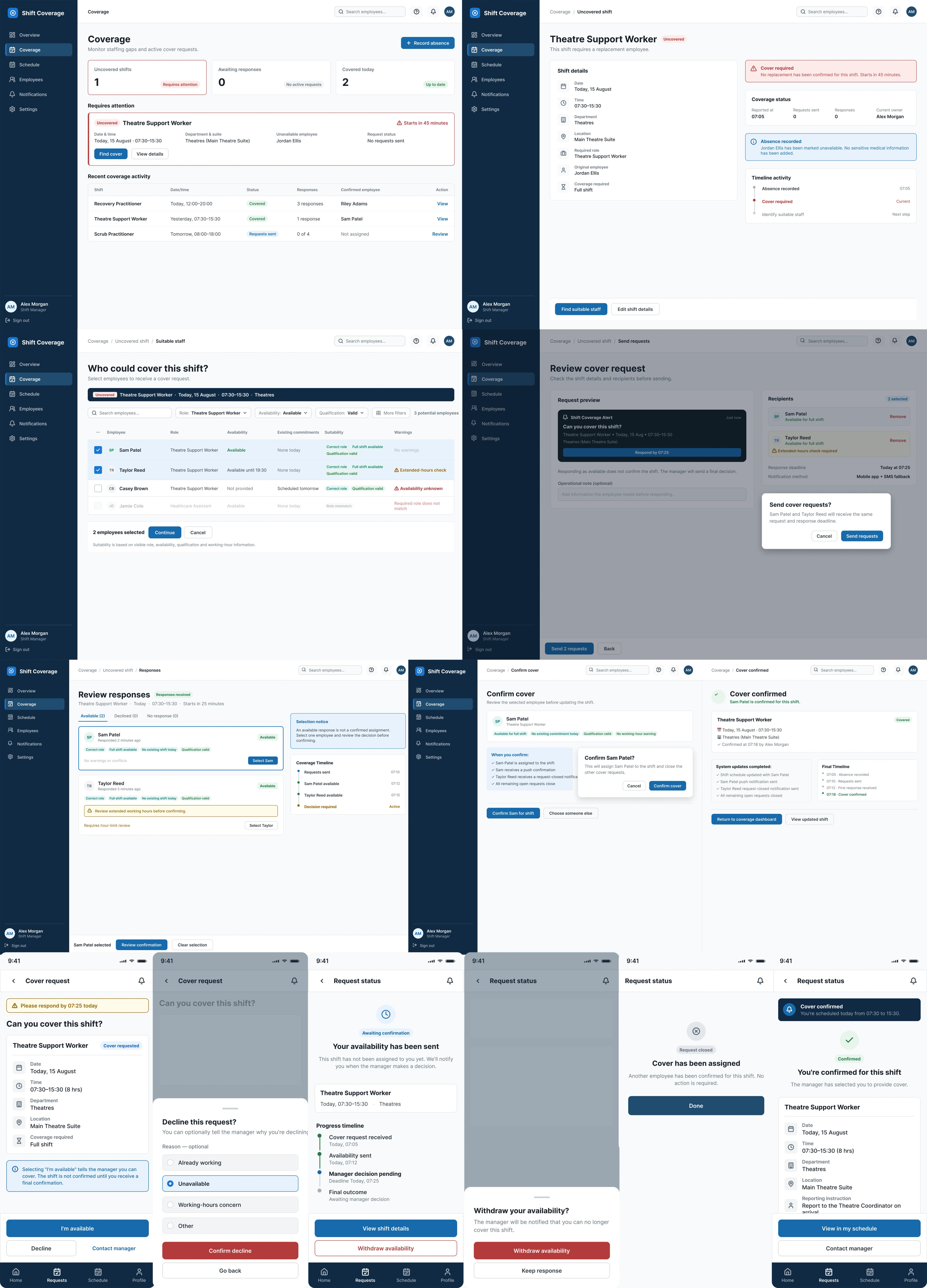
Desktop manager and mobile employee interfaces showing the workflow from an uncovered shift to confirmed replacement cover.

A role-based coverage workflow connecting manager decision-making with clear employee responses and confirmation.

Role

Product Designer

Timeline

2 Weeks

Platform

Manager desktop and employee mobile

Tools

FigmaFigJam

Team

Independent product-design project

Responsibilities

DiscoveryCompetitor researchProduct strategyUX flowsWireframingUI designDesign systemPrototyping

01 — Discovery & Requirements

Understanding the problem before designing the solution

Problem Statement

When an employee reports sickness shortly before a shift, managers must quickly identify suitable replacements, contact several off-duty employees, wait for responses and communicate the final decision. This process is fragmented across phone calls and verbal updates, creating limited visibility, delayed responses and uncertainty for everyone involved. When cover cannot be secured, operational pressure transfers to employees already working, who may need to extend their scheduled hours.
How Might We

How might we help shift managers move from a short-notice absence report to confirmed cover—or an appropriate escalation—while keeping employee suitability, responses and final decisions clear?

This concept was inspired by recurring workforce-coordination problems I observed while working as a Theatre Support Worker in a shift-based hospital environment.

Staff reported sickness by calling the duty coordinator between 07:00 and 07:30. The coordinator informed the manager, who then contacted off-duty employees individually to find replacement cover. Updates were communicated verbally to the affected team.

When no replacement was available, employees already working sometimes had to extend their shifts from 07:30–15:30 to 07:30–19:30, occasionally across consecutive days.

This case study is an independent product-design exploration based on personal operational observations. It was not commissioned by my former employer and does not use patient, employee or proprietary organisational data.

Constraints

Short-notice decisions must be made before or during an affected shift.Employee availability does not guarantee acceptance or assignment.Role, qualification and working-hour requirements affect suitability.Managers retain final responsibility for confirming cover.Sensitive medical information must not be shared with other employees.The system cannot create suitable staff when none are available.The concept is based on first-hand observation and requires further user validation.

02 — Research & UX Strategy

Understanding the existing experience

First-hand operational observationCurrent-state journey mappingSecondary competitor researchWorkflow analysisAssumption mappingProto-personas

01

1. Cover coordination is fragmented

Evidence: Absences, staff outreach and final updates were handled through separate phone calls and verbal communication. Description: Managers lacked one visible place to track the uncovered shift, contacted employees and current responses.

Design response

Create one absence-to-resolution workflow with clear ownership and status tracking.

02

2. Availability is not confirmation

Evidence: An employee may be available and willing to help, but the manager still needs to decide who will cover. Description: Treating an employee response as an automatic assignment could create confusion or double coverage.

Design response

Separate “I’m available” from final manager confirmation.

03

3. Suitability involves operational constraints

Evidence: Cover depends on role, qualifications, existing commitments, availability and working-hour considerations. Description: A simple list of off-duty employees does not provide enough information for a safe decision.

Design response

Show explainable suitability information and warnings without automatically assigning anyone.

04

4. Every request needs a clear outcome

Evidence: Verbal updates and individual calls can leave employees uncertain about whether cover has been secured. Description: Employees need to know whether they are awaiting a decision, confirmed or no longer required.

Design response

Notify every affected employee when the manager confirms cover or closes the request.

Personas

Journey Map

Competitive Analysis

I reviewed Deputy, RotaCloud, Planday and Shift Flow UK using publicly available product pages and help documentation. These platforms already support established workforce-management capabilities such as rota creation, employee availability, open shifts, shift swaps, notifications and manager approval.

The review showed that this concept is not a new software category. Its opportunity lies in simplifying one urgent operational journey: moving from a reported absence to confirmed internal cover or a clearly escalated outcome.

The proposed experience focuses on clear workflow ownership, visible suitability information, one request sent to several eligible employees, separation of employee availability from manager confirmation, and notifications that close the communication loop.

UX Strategy

Turning insight into product direction

Product Goal

Enable a shift manager to move one short-notice absence from reported to confirmed cover—or a clearly escalated outcome—through a visible, coordinated and trackable workflow.

Success Criteria

Managers can immediately identify an uncovered shift.Managers can identify suitable employees using visible eligibility and availability information.Managers can send one cover request to several employees without repeating the workflow.Employees can understand the shift details and respond with minimal effort.Employee availability remains separate from final manager confirmation.Managers can track available, declined and unanswered responses.One employee can be confirmed without creating multiple assignments.All affected employees receive a clear final outcome.Unresolved coverage remains visible and can be escalated.

Product Principles

Focus on resolution, not broad workforce management.Make the uncovered shift and next action immediately visible.Show why an employee may be suitable or require review.Keep employee availability separate from manager confirmation.Close every request with a clear final outcome.Close every request with a clear final outcome.Keep unresolved coverage visible and actionable.

Decision Log

Decision 01

Design one absence-to-resolution workflow rather than a complete rota platform.

The highest operational friction occurs after an unexpected absence.

Intended impact: The MVP remains focused and achievable.

Decision 02

Employee availability will not automatically assign the shift.

Managers remain responsible for reviewing suitability and making the final decision.

Intended impact: Prevents accidental or conflicting assignments.

Decision 03

Allow one cover request to be sent to multiple suitable employees.

Repeated individual outreach delays the process.

Intended impact: Reduces duplicated coordination while preserving one final assignment.

Decision 04

Display role, availability, qualifications, commitments and working-hour warnings.

Managers need understandable evidence when choosing cover.

Intended impact: Supports safer, more transparent decisions without presenting an unexplained recommendation.

Decision 05

Notify confirmed, unsuccessful and no-longer-required employees of the final outcome.

An expression of availability can otherwise remain unresolved.

Intended impact: Reduces uncertainty for employees and managers.

Decision 06

Treat no suitable staff and no response as explicit workflow outcomes.

Software cannot guarantee that replacement cover exists.

Intended impact: Managers can escalate unresolved coverage instead of encountering a dead end.

03 — Information Architecture & User Flows

Structuring the experience around customer intent

Information Architecture

The product uses a role-based architecture centred on one shared coverage case.
Manager desktop: • Coverage dashboard • Uncovered shift details • Suitable staff selection • Cover-request review • Employee responses • Confirmation or escalation
Employee mobile: • Cover request • Accept or decline response • Awaiting confirmation • Confirmed or closed outcome
Both experiences use the same coverage statuses: Uncovered, Requests Sent, Awaiting Responses, Decision Required, Covered or Escalated.

Primary User Flow

The primary flow follows one short-notice absence from initial reporting to confirmed replacement cover. The manager reviews the uncovered shift, identifies suitable employees and sends the same request to several people. Employees respond independently, but availability does not assign the shift. The manager reviews responses, confirms one employee and the system updates the rota while notifying everyone affected.

04 — Wireframes

Translating the journey into screens

Low-fidelity wireframes were created to test the complete absence-to-cover workflow before applying visual styling. The manager experience prioritised immediate visibility of uncovered shifts, explainable staff suitability, request tracking and final confirmation. The employee mobile flow focused on communicating essential shift information, enabling a quick response and clearly distinguishing availability from confirmed assignment.

The wireframes deliberately kept the workflow narrow, using six primary manager screens and three core employee states to move from an uncovered shift to confirmed cover.

Wireframes

05 — Design System

Building a consistent visual language

The visual direction prioritises calm clarity during time-sensitive coordination. A dark navy navigation system provides structure, while blue communicates primary actions and active states. Green indicates successful coverage, amber highlights information requiring review and red is reserved for genuinely urgent or unresolved conditions. Clean typography, generous spacing and restrained surfaces help managers scan operational information quickly without making the interface feel alarmist.

Design System

Accessibility Decisions

Status is communicated with text and icons, not colour alone.Primary text and controls use strong foreground-to-background contrast.Interactive controls have clear hover, focus, selected and disabled states.Buttons and mobile actions use adequately sized touch targets.Labels remain visible instead of relying only on placeholder text.Urgent colours are reserved for genuinely time-sensitive or unresolved states.Plain language distinguishes availability, pending confirmation and assignment.Information is organised with clear headings and predictable reading order.

06–07 — Final UI

The final responsive product experience

The final solution connects a focused manager desktop workflow with a simple employee mobile response experience. Managers can see an uncovered shift, review suitable employees, send one request to several people, track responses and confirm one replacement. Employees receive the essential shift details, indicate whether they are available and remain in a clear pending state until the manager makes the final decision. Once cover is confirmed, the shift is updated and every affected employee receives an explicit outcome. When cover cannot be secured, the unresolved state remains visible for operational escalation.

A clearer path from staffing gap to confirmed cover

The final interface translates the proposed workflow into two connected role-based experiences: a desktop workspace for managers and a focused mobile journey for employees.

The manager experience makes uncovered shifts immediately visible, explains why employees may be suitable, supports one request to several people and keeps the final assignment under human control.

The employee experience communicates only the information needed to make a decision, provides clear response options and uses separate awaiting, confirmed and closed states to prevent misunderstanding.

Together, these experiences replace fragmented outreach and verbal updates with one visible sequence of actions, responses and final outcomes.

Experience 01

1. Identifying the staffing gap

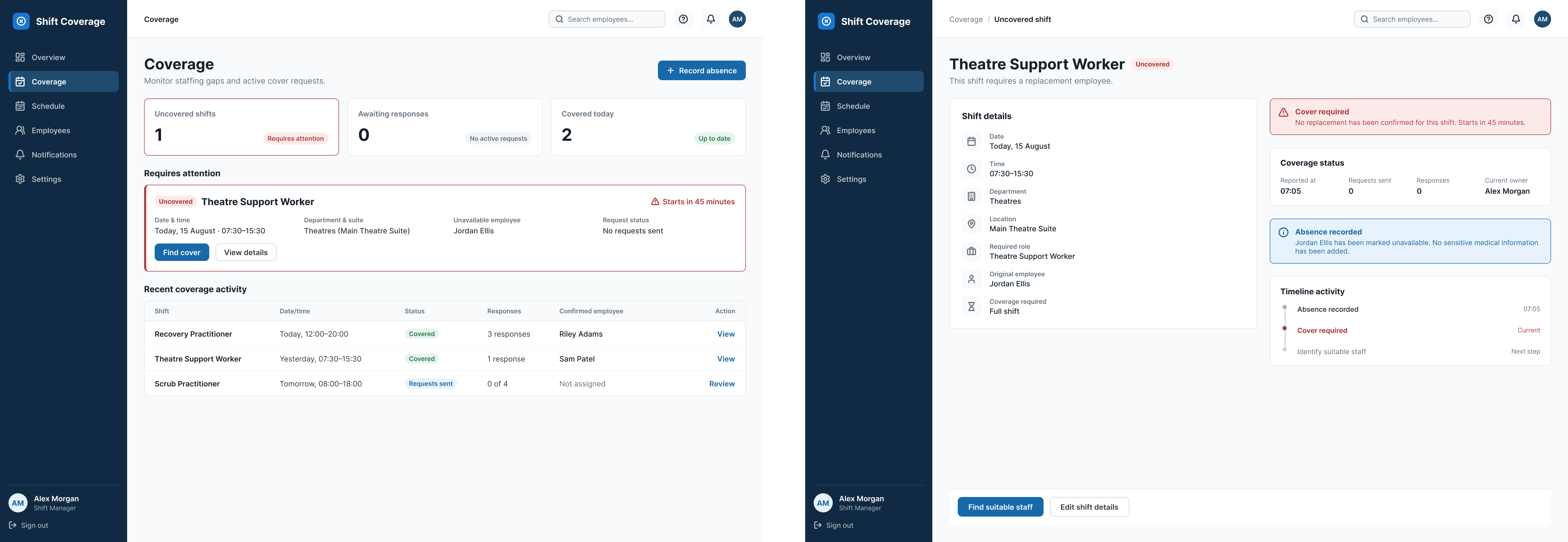
Uncovered shifts are prioritised on the manager dashboard so the manager can move directly from awareness to action. The shift-details view brings together timing, role, location, original employee and current coverage status.

“Manager coverage dashboard highlighting one urgent uncovered shift, followed by a detailed view of the affected Theatre Support Worker shift.”
Prioritising uncovered shifts helps managers identify urgent staffing gaps and move directly into the coverage workflow.

Experience 02

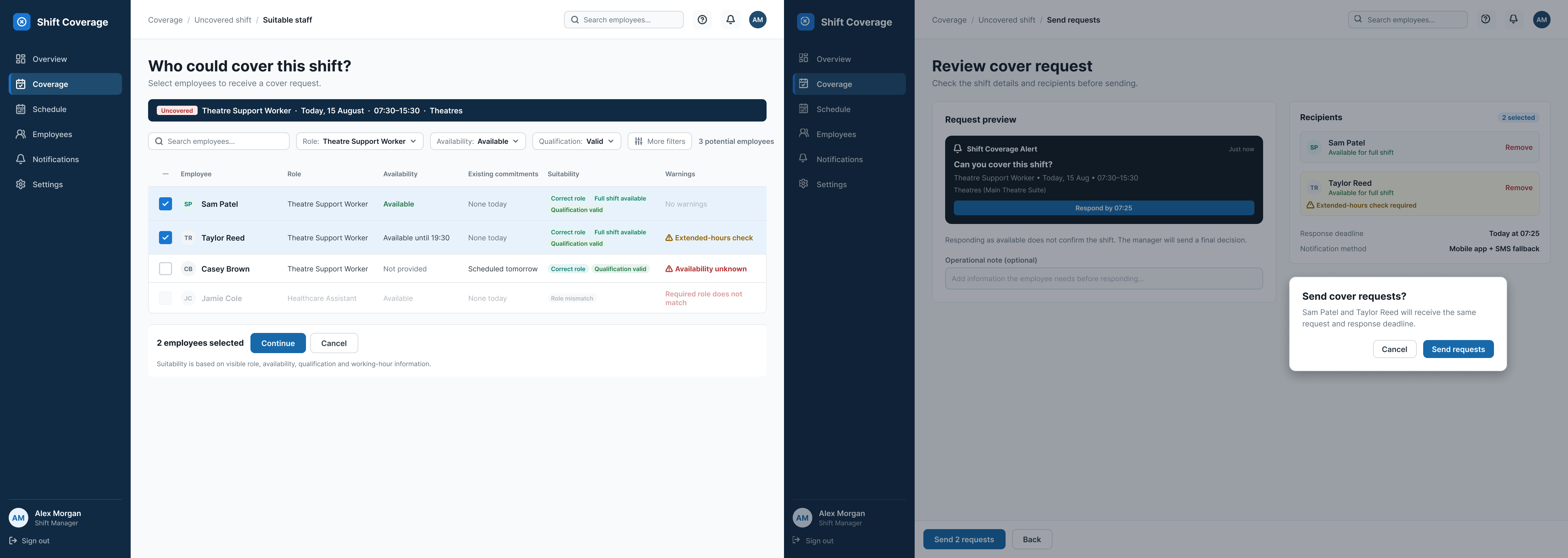
2. Selecting staff and sending requests

Managers can compare employees using visible role, availability, qualification, existing-commitment and working-hour information. One request can then be sent to several suitable employees without repeating the workflow.

“Manager screens for comparing suitable employees and reviewing a cover request before sending it to two selected recipients.”
Explainable suitability information supports faster staff selection while keeping working-hour warnings and eligibility concerns visible.

Experience 03

3. Reviewing responses and confirming cover

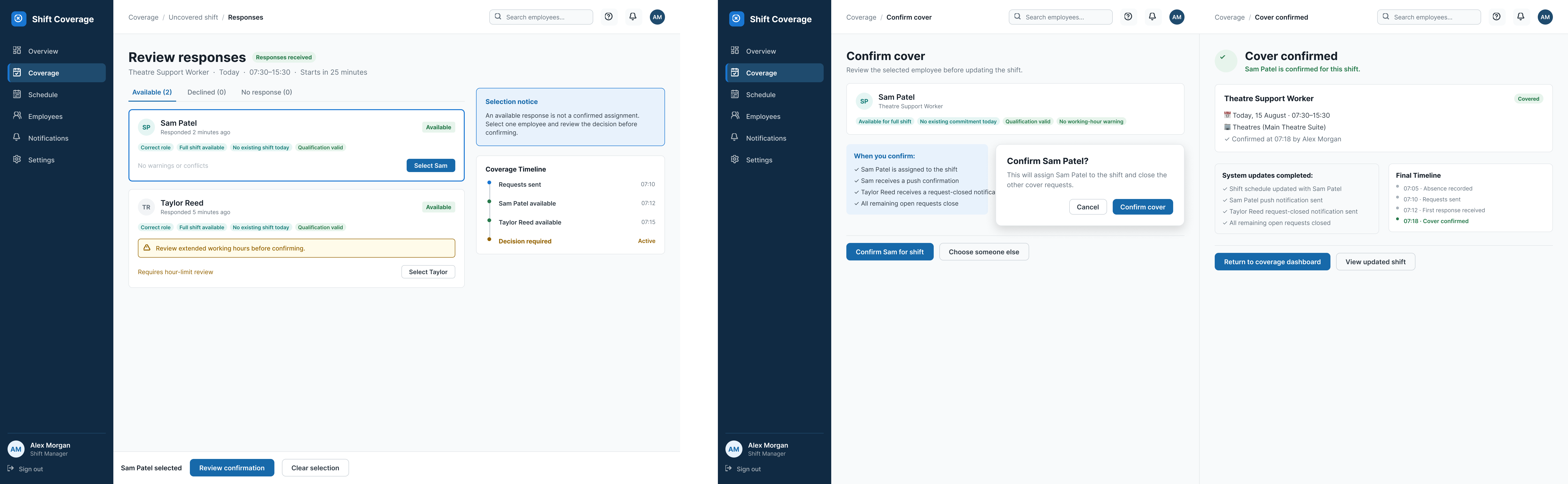
Available responses are grouped separately from declines and unanswered requests. The manager reviews any warnings, selects one employee and confirms the assignment before the shift and notifications are updated.

Manager screens showing two employee responses, selection of one suitable employee and confirmation that the shift has been covered.
Separating employee availability from final confirmation keeps assignment decisions controlled, traceable and unambiguous.

Experience 04

4. Employee response and outcome

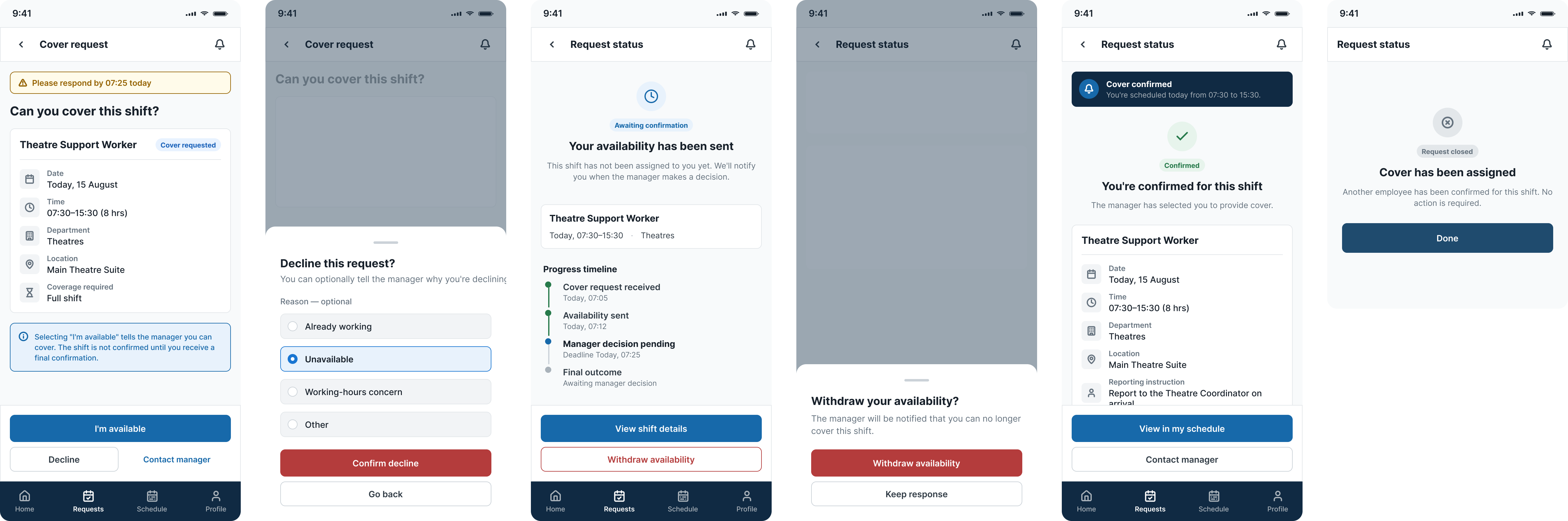
The mobile experience presents the essential shift details and makes it clear that declaring availability is not the same as being assigned. Employees move through distinct request, awaiting-confirmation and confirmed states.

“Employee mobile screens for receiving a cover request, declaring availability, awaiting the manager’s decision and receiving confirmed shift details.”
Distinct request, awaiting and confirmed states help employees understand what has happened and whether the shift has been assigned to them.

Prototype

Testing the complete journey

08 — Edge Cases & System States

Designing beyond the happy path

Short-notice cover cannot always be resolved through the ideal path. The concept therefore includes explicit states for situations where no suitable employee can be identified, nobody responds before the deadline or several employees volunteer for the same shift. These states keep the manager in control, prevent multiple assignments and ensure that employees receive a clear outcome rather than remaining in an unresolved request.

Proposed System State

1. No suitable staff

Scenario

No employee meets the required role, qualification, availability or working-hour requirements.

Problem

The system cannot manufacture suitable cover, but the manager still needs a clear next step.

Response

Display an explicit “No suitable staff found” state, explain the applied suitability criteria and provide options to adjust the search or escalate the uncovered shift.

Why it matters

Prevents a dead end and keeps operational responsibility visible.

Proposed System State

2. Nobody responds

Scenario

Cover requests have been sent, but no employee accepts or declines before the response deadline.

Problem

The manager must distinguish unanswered requests from confirmed unavailability and act before the shift begins.

Response

Keep the shift marked as uncovered, identify unanswered requests and provide actions to resend, contact additional staff or escalate.

Why it matters

Ensures silence is not treated as a negative response or successful resolution.

Proposed System State

3. Multiple employees are available

Scenario

More than one employee declares availability for the same uncovered shift.

Problem

Multiple positive responses could create duplicate assignments or leave employees unsure about the outcome.

Response

Present all available responses to the manager, allow only one employee to be confirmed and automatically close the remaining requests with a clear notification.

Why it matters

Preserves manager control and prevents double coverage.

10 — Impact & Outcomes

From business problems to product outcomes

This project transformed a recurring operational problem observed in shift-based employment into a focused B2B SaaS concept. The final prototype demonstrates how one role-based workflow could connect absence reporting, suitable-staff identification, cover requests, employee responses, manager confirmation, rota updates and final notifications. The work produced a defined MVP, manager desktop experience, employee mobile experience, reusable design system, interactive prototype and three operational edge cases. As the product has not been developed or tested in a live organisation, no claims are made about measured business impact, time savings or reduced overtime.

Delivered Outcomes

Clearer coverage coordination

A single visible workflow could reduce fragmented phone calls, repeated outreach and uncertainty about the current coverage status.

Faster manager decision-making

Explainable suitability information could help managers identify appropriate employees and review warnings more efficiently.

Reduced employee uncertainty

Separate requested, awaiting, confirmed and closed states could help employees understand whether they have actually been assigned.

More consistent communication

Automatic final notifications could ensure that confirmed and unsuccessful employees receive a clear outcome.

Better handling of unresolved coverage

Explicit no-suitable-staff and no-response states could support earlier operational escalation.

Expected Business & UX Impact

Time to secure cover

Time between recording an absence and confirming a replacement.

Coverage success rate

Percentage of uncovered shifts filled before their scheduled start.

Manager coordination effort

Number of manual calls or messages required per coverage case.

Employee response rate

Percentage of cover requests receiving a response before the deadline.

Decision clarity

Percentage of employees who correctly understand whether they are pending, confirmed or no longer required.

Extended-hours frequency

Number of instances where existing staff work beyond their scheduled finishing time due to unavailable cover.

Success Metrics / Future Measurement

1. Time to secure cover

Average time between recording an employee’s absence and confirming a replacement.

2. Coverage success rate

Percentage of uncovered shifts successfully filled before their scheduled start time.

3. Manager coordination effort

Average number of manual calls, messages and repeated actions required to resolve one uncovered shift.

4. Employee response rate

Percentage of cover requests that receive an available or declined response before the stated deadline.

5. Decision clarity

Percentage of employees who correctly understand whether their response is awaiting confirmation, confirmed or no longer required.

6. Extended-hours frequency

Number of occasions when existing employees work beyond their scheduled finishing time because replacement cover was unavailable.

11 — Reflection & Next Steps

Learning from the product and looking forward

This project showed how first-hand exposure to an operational problem can provide a strong starting point without being treated as complete research evidence. The most important design decision was narrowing the concept from broad workforce scheduling to one time-critical workflow: moving from a reported absence to confirmed cover or an explicit escalation. This focus made it possible to explore role-based experiences, operational constraints, decision ownership, status communication and failure states in greater depth. The final concept demonstrates a coherent proposed workflow, but it has not been tested with managers or shift-based employees. Its usability, organisational fit and potential impact therefore remain hypotheses requiring validation.

01

1. Scope creates depth

Narrowing the product to one operational workflow produced a clearer and more convincing concept.

Takeaway

A focused problem can demonstrate systems thinking more effectively than a broad feature list.

02

2. Interest is not assignment

Employee availability and manager confirmation are different decisions.

Takeaway

Explicit intermediate states can prevent serious operational misunderstandings.

03

3. Failure paths are part of the product

Short-notice cover cannot always be secured.

Takeaway

No-response and no-suitable-staff states require clear recovery and escalation actions.

04

4. Suitability should be explainable

Managers need to understand why an employee may or may not be appropriate.

Takeaway

Visible criteria and warnings are more trustworthy than an unexplained recommendation.

Key Trade-offs

Decision

Exclude rota creation, payroll, attendance and long-term workforce planning.

Why

These capabilities already exist in established platforms and would dilute the core workflow.

Trade-off

The concept depends on integration with an existing scheduling system.

Decision

Send one request to several suitable employees simultaneously.

Why

Sequential contact could delay urgent coverage.

Trade-off

More than one employee may volunteer, requiring a separate confirmation stage.

Decision

Keep the manager responsible for final assignment.

Why

Suitability may involve operational judgement and working-hour considerations.

Trade-off

The manager must complete an additional decision step.

Decision

Show only the information needed to coordinate cover.

Why

Employees do not need access to another employee’s absence or medical details.

Trade-off

Some context remains restricted to authorised managers.

What Still Needs Validation

Manager workflow fit

Whether managers follow the proposed sequence and have authority to confirm cover.

Suitability criteria

Which role, qualification, availability and working-hour checks are mandatory.

Employee comprehension

Whether employees understand that “I’m available” is not final assignment.

Response behaviour

Whether employees respond more reliably through app notifications than phone calls.

Escalation process

What managers should do when nobody responds or no suitable staff exist.

Information privacy

What employee information may be displayed to different roles.

System integration

How confirmed cover should update an organisation’s existing rota platform.

Next Steps

Interview shift managers, coordinators and shift-based employees.

Validate suitability rules with operational and HR stakeholders.

Test the primary workflow using realistic short-notice scenarios.

Evaluate comprehension of available, awaiting and confirmed states.

Test the three edge cases and escalation actions.

Explore integration with existing rota and notification systems.

Measure the future success metrics during a controlled pilot.

What I Would Do Differently

With more time, I would begin with interviews involving shift managers, duty coordinators and shift-based employees from several organisations. I would use these conversations to compare current processes, confirm decision authority and identify the operational rules used to determine suitability. I would then test the low-fidelity workflow before developing the visual system, with particular attention to response language, manager confirmation, working-hour warnings and escalation states. Finally, I would run a scenario-based usability test using a time-sensitive uncovered shift and revise the prototype using observed behaviour rather than assumptions.

Final Reflection

The strongest outcome of this project is not a new scheduling platform, but a focused operational workflow built around clear ownership, explainable decisions and closed communication loops. It demonstrates how I approach complex B2B problems: begin with observed friction, separate evidence from assumptions, reduce the scope, map responsibilities across roles and design for both the ideal path and the moments when the system cannot provide an easy answer. The concept now provides a credible foundation for further research, usability testing and technical feasibility work.

More Work

Explore more selected projects

Back to Projects →